 Aaron Beaudoin
Research · Astrophysics
Searching for Imprints of Circumstellar Material in the Ultraviolet Spectra of Type Ia Supernovae
Do exploding white dwarfs leave gas behind from a companion star? I measured Hubble ultraviolet spectra of 8 supernovae to find out.
At a glance
- My role
- My own project, with guidance from Professor Ryan Foley, as a research assistant at the University of Illinois.
- What I did
- Wrote Python scripts to measure absorption lines in 46 Hubble Space Telescope ultraviolet spectra, then checked whether any of them changed over time.
- The result
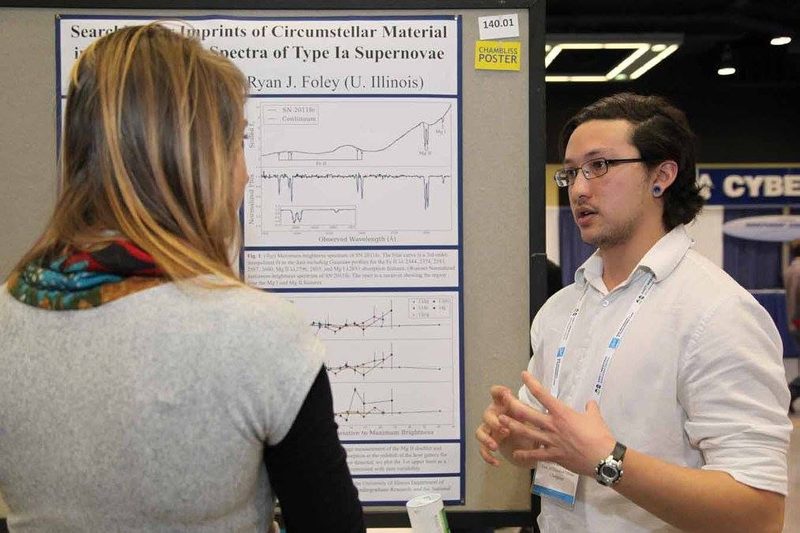
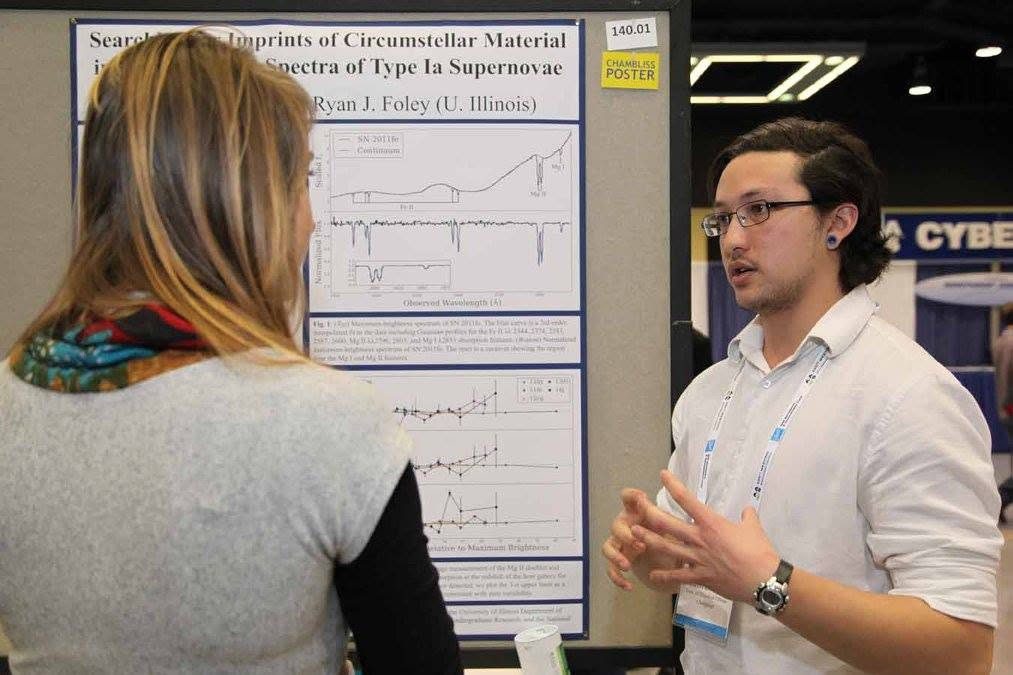
- None of the lines changed, which put new limits on the kind of star systems these supernovae come from. I presented it as a poster at the American Astronomical Society meeting in 2014 and at the University of Illinois Undergraduate Research Symposium in 2015, where the poster is archived.
- 8 Type Ia supernovae
- 46 Hubble ultraviolet spectra
- 3 elements tracked: Mg I, Mg II, Fe II
Type Ia supernovae (SNe Ia) are thermonuclear explosions that have high and relatively standard peak luminosities. It is accepted that SNe Ia originate in white dwarf (WD) binary systems, however, the companion star is still unclear. Two possible progenitor models are the single- (SD) and double-degenerate (DD) scenarios, where the companion in the DD scenario is another WD, while the companion in the SD scenario is a more normal star such as a red giant.
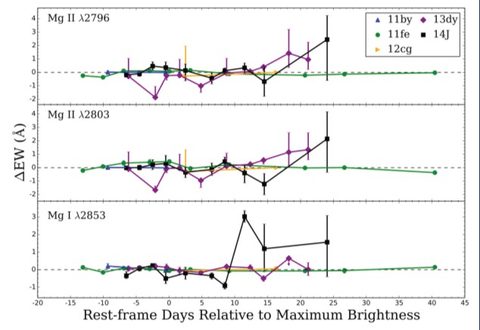
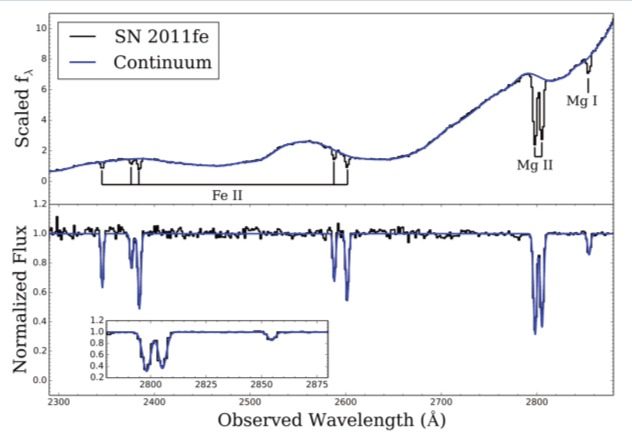
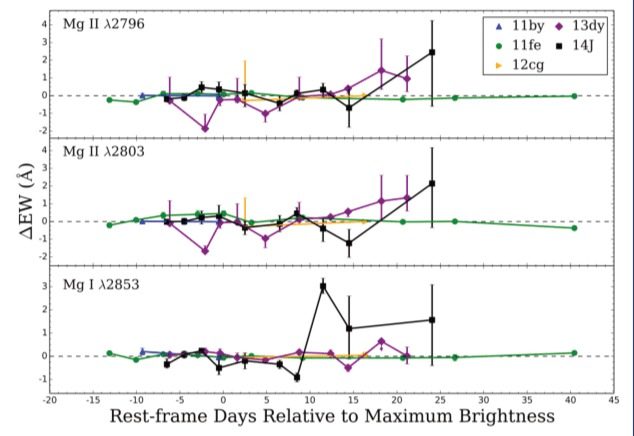
Here, we test these models by searching for indications of circumstellar material (CSM) in Hubble Space Telescope UV spectra of 8 SNe Ia. Imprinted on these UV spectra are narrow absorption lines from ISM and/or CSM. If these features vary in strength over time, the material is likely CSM, ionizing and recombining after the SN explosion. Such material is most easily explained in a SD progenitor system. Using a total of 46 spectra from 8 SNe Ia, we do not detect any variability in Mg I, Mg II, and Fe II lines, placing new, strong constraints on the progenitor systems of these SNe Ia.
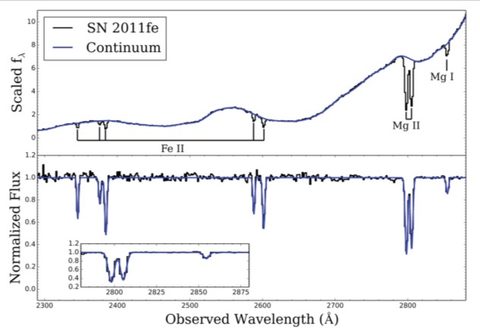
We detect the Mg II λ2800 doublet and Mg I λ2853 in all spectra, although SNe 1992A, 2011ek, and 2011iv only show absorption from the Milky Way. We also detect Fe II in some observations from each SN. Measuring the EW of each feature at each epoch, we look for any variability. In our best measurements to date, we do not detect any significant change in any of the absorption features, consistent with studies of optical features for SN 2011fe (Patat et al., 2013) and SN 2014J (Welty et al., 2014; Goobar et al., 2014, Foley et al., 2014). We therefore do not detect a large amount of CSM along our line of sight.
References
- Patat et al., 2013, A&A, 549, 62.
- Welty et al., 2014, ApJ, 792, 2.
- Goobar et al., 2014, ApJL, 784 12.
- Foley et al., 2014, MNRAS, 433, 2887.